
Target Website: https://allrummyss.com
Introduction to Rummy 51 Rules
Rummy is a popular card game that combines observation, planning, and logical thinking. Among its different variations, Rummy 51 is a name that players may encounter when searching for a version of the game with a 51-point opening requirement. Learning the rules before playing can help beginners understand card combinations, manage their hands, and avoid common mistakes.
If you want to explore more card-game guides, tutorials, and related information, visit AllRummyss.com. The website can serve as a starting point for readers who want to learn about different rummy games and their basic gameplay concepts.
One important detail is that the name “Rummy 51” can refer to different formats. In one version, players must lay down valid combinations worth at least 51 points before opening their hands. In another format, the number 51 may refer to a cumulative score limit in a pool-style game. The exact rules can also vary by platform and playing group.
This guide focuses primarily on the opening-51 version while explaining the distinction between these formats.
Top Rummy – https://rummy-top.com/
What Is Rummy 51?
Rummy 51 is a rummy variation in which players aim to organize their cards into valid sequences and sets. The main objective is to form acceptable combinations and get rid of the cards in your hand before your opponents do.
The key feature of the opening-51 version is its initial melding requirement. A player must place valid combinations on the table with a combined value of at least 51 points before they can begin laying down additional combinations under the usual rules of that version.
For example, a player might combine a high-value sequence with a set of matching-rank cards to reach the required opening score.
However, reaching 51 points is not enough if the combinations themselves are invalid. Players must understand how sequences, sets, jokers, and card values work before attempting to open.
1. Objective of Rummy 51
The main objective is to arrange your cards into valid combinations and reduce the number of unmatched cards remaining in your hand.
Depending on the rules used at the table, players generally try to:
- Build sequences of consecutive cards from the same suit.
- Create sets containing cards of the same rank.
- Meet the initial 51-point opening requirement.
- Draw useful cards and discard less useful ones.
- Use jokers according to the permitted rules.
- Finish the round before the other players.
The player who completes the required combinations and gets rid of their cards first may win the round, provided the final declaration or ending meets the rules of that version.
2. Number of Players and Cards Required
The number of players, decks, jokers, and cards dealt can differ between Rummy 51 versions.
Some opening-51 versions use two standard decks with jokers, while other implementations may use different deck arrangements or starting hand sizes. Before starting, confirm the setup specified by your chosen game or agreed upon by the players.
A typical setup may include:
- Two or more players.
- One or two standard decks, depending on the version.
- Jokers, if included in the selected rules.
- A face-down draw pile.
- A face-up discard pile.
- A dealer who distributes the starting cards.
After dealing, the remaining cards form the draw pile. A card may be placed face-up beside it to begin the discard pile.
Do not assume every Rummy 51 table uses the same setup. Checking the rules first prevents confusion during the game.
3. Understanding the 51-Point Opening Rule
The opening requirement is the most important rule in this version of Rummy 51.
Before placing your first combinations on the table, you must form valid melds whose total point value reaches at least 51. In versions that require a pure sequence for opening, at least one of those combinations must be a sequence made without a joker.
A player with combinations worth only 50 points cannot open under a strict 51-point rule. They must continue collecting useful cards until they can meet the requirement.
Example of a 51-point opening
Consider these combinations:
Combination A: Jack, Queen, and King of Clubs
- Jack of Clubs = 10 points
- Queen of Clubs = 10 points
- King of Clubs = 10 points
Total = 30 points.
Combination B: Three sevens from different suits
- Seven of Hearts = 7 points
- Seven of Diamonds = 7 points
- Seven of Spades = 7 points
Total = 21 points.
Combined opening value: 30 + 21 = 51 points.
This example reaches the required score exactly. However, it is a valid opening only if both combinations satisfy the table’s rules and the required pure-sequence condition is met. The three-card face-card sequence is a pure sequence because it uses consecutive cards of the same suit without a joker.
4. What Is a Sequence in Rummy 51?
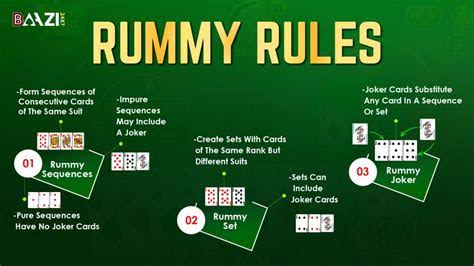
A sequence is a group of three or more consecutive cards from the same suit.
For example:
- 4, 5, 6 of Hearts
- 7, 8, 9 of Spades
- 10, Jack, Queen of Diamonds
Each group follows a consecutive order and contains cards of the same suit.
A sequence becomes invalid if its cards do not follow the required order or belong to different suits.
For example, 5 of Hearts, 6 of Clubs, and 7 of Hearts do not form a standard sequence because the suits are different.
Pure sequence
A pure sequence is formed without using a joker as a substitute for another card.
Example: 6, 7, and 8 of Spades.
Some Rummy 51 rules require at least one pure sequence when a player makes the initial opening. A pure sequence is also a fundamental requirement in many other rummy formats.
Impure sequence
An impure sequence uses a permitted joker to replace a missing card.
For example, 5 of Hearts, a joker representing 6 of Hearts, and 7 of Hearts may form a valid impure sequence if the selected rules allow it.
Always check whether your version permits jokers in the opening combinations and whether a pure sequence is mandatory.
5. What Is a Set in Rummy 51?
A set is a group of three or four cards of the same rank, generally from different suits.
Examples include:
- 8 of Hearts, 8 of Clubs, and 8 of Diamonds.
- King of Spades, King of Hearts, and King of Diamonds.
- 4 of Hearts, 4 of Spades, 4 of Diamonds, and 4 of Clubs.
The defining feature of a set is that the cards share the same rank rather than forming a consecutive sequence.
A set can help you reach the opening requirement when its combined value contributes enough points. It can also help organize the remaining cards after you have opened.
Avoid treating any three cards of the same number as a valid set without checking the suit restrictions. Some rules do not allow duplicate suits within the same set.
6. Card Values in Rummy 51
Card values are important because the opening requirement depends on the total value of your valid combinations.
A common scoring system for the opening-51 variation is:
| Card | Typical point value |
| Number cards 2–9 | Face value |
| 10 | 10 points |
| Jack | 10 points |
| Queen | 10 points |
| King | 10 points |
| Ace | Depends on its permitted use and the variant |
| Joker | Depends on the rules and the card it represents |
For example, a 6, 7, and 8 sequence totals 21 points. Three kings total 30 points under this scoring system.
Aces may be counted differently depending on their position and the rules being used. Some versions also assign a separate penalty value to unused jokers at the end of a round.
For this reason, the table’s official scoring rules should take priority over a general guide.
7. How to Play Rummy 51 Step by Step
Understanding the turn sequence makes the game easier to follow.
Step 1: Receive your cards
The dealer distributes the agreed number of cards to each player. Players organize their cards by suit, rank, and possible combinations.
Step 2: Examine your hand
Look for sequences and sets that can help you meet the opening requirement. Identify cards that could complete an existing combination and cards that currently have little value to your plan.
Step 3: Draw a card
On your turn, draw one card from the face-down pile or take the top card from the discard pile if the rules permit it.
Step 4: Check possible combinations
After drawing, review your hand. Determine whether the new card helps you form a valid sequence or set and whether your opening combinations meet the required point total.
Step 5: Open when eligible
Once you can satisfy the 51-point requirement and any additional opening conditions, lay down the valid combinations as permitted by the rules.
If you cannot meet the requirement, continue building your hand and avoid making an invalid opening.
Step 6: Discard a card
Choose a card that is not useful for your current combinations and discard it according to the rules. Consider whether another player might benefit from the card before you release it.
Step 7: Continue arranging your hand
After opening, many versions allow players to lay down additional combinations or add suitable cards to combinations already on the table. These actions are often called melding and laying off.
The exact permissions depend on the particular Rummy 51 rules.
Step 8: Complete the round
Try to arrange the remaining cards into valid combinations and finish according to the required ending procedure. Check whether the last card must be discarded and whether a final declaration is necessary.
8. Rules for Using Jokers
Jokers can make it easier to complete combinations, but their use is controlled by the selected game rules.
In many rummy variations, a joker can replace a missing card in an otherwise valid sequence or set. This can help players complete combinations when they cannot draw the exact card they need.
Keep these points in mind:
- Confirm whether the game uses printed jokers, wild jokers, or both.
- Check whether a joker is allowed in the initial opening combinations.
- Do not use a joker to create a pure sequence.
- Understand whether a joker can be retrieved from an existing combination.
- Check the penalty value of an unused joker at the end of a round.
A joker is useful when it completes a genuine combination. However, using one incorrectly can make a combination invalid.
9. Common Mistakes to Avoid
Beginners can improve their understanding of Rummy 51 by avoiding several common mistakes.
Opening before reaching 51 points: Calculate the value of your valid combinations carefully before laying down your first meld.
Ignoring the pure-sequence requirement: If your version requires a pure sequence, reaching 51 points without one may not be sufficient.
Mixing suits in a sequence: Consecutive ranks alone do not make a valid sequence. The suit must also meet the rules.
Creating an invalid set: Check that the cards have the same rank and comply with the permitted suit arrangement.
Discarding useful cards: Think about which cards you may need to complete a sequence or set before discarding.
Forgetting scoring rules: Card values and penalty calculations may vary, especially for aces and jokers.
Assuming all versions are identical: Always read the rules for the exact table or variant you are playing.
10. Beginner Tips for Better Rummy 51 Decisions
Good decisions begin with organizing your cards and understanding what combinations are possible.
- Sort cards by suit: This makes consecutive sequences easier to identify.
- Look for natural sequences: A sequence that does not need a joker may satisfy the pure-sequence requirement.
- Calculate opening points early: Knowing your current total helps you identify what is missing.
- Keep track of discarded cards: Previously discarded cards may help you assess which combinations are still realistic.
- Avoid holding unnecessary high-value cards: In versions where unmelded cards carry penalties, unused high-value cards can increase your final score.
- Use jokers thoughtfully: Save them for combinations where they provide meaningful flexibility.
- Stay adaptable: A useful card can change your best plan, so review your hand after each draw.
- Learn through practice: Start with free practice games or friendly offline rounds to understand the sequence of play.
These suggestions can help you make more informed decisions, but they cannot guarantee a win. Card distribution and the choices made by other players always affect the result.
11. Is Rummy 51 the Same as 51 Pool Rummy?
No. The two names can describe different rule structures.
In the opening-51 version, the number 51 refers to the minimum point value required for the first valid meld. Players must meet that requirement before opening.
In 51 Pool Rummy, the number may instead refer to the cumulative penalty-point limit. Players typically play successive deals, and a player’s accumulated score determines when they are eliminated from the pool.
Pool-style Indian rummy generally uses its own declaration requirements, including sequence and joker rules. The 51-point opening requirement should not automatically be applied to it.
Before starting, check whether the game is described as an opening-51 variation or a 51-point pool format. This small step can prevent major misunderstandings.
12. Frequently Asked Questions About Rummy 51 Rules
What is the main rule of Rummy 51?
In the opening-51 variation, the first combinations laid down must total at least 51 points. Additional requirements, such as a pure sequence, depend on the selected rules.
Can I open with exactly 51 points?
Yes, in a version that requires a minimum of 51 points, a valid opening worth exactly 51 meets the numerical threshold. All required combination and pure-sequence conditions must also be satisfied.
Can I use a joker in a pure sequence?
No. A pure sequence is formed without a joker substituting for a missing card. A joker may be permitted in an impure sequence if the variant allows it.
Are all Rummy 51 games played with the same number of cards?
No. Deck size, player count, hand size, and joker arrangements may differ. Check the rules of your chosen version.
Is Rummy 51 the same as ordinary Indian Rummy?
Not necessarily. Some formats use a 51-point opening requirement, while Indian points or pool rummy may use different scoring and declaration rules.
Does learning Rummy 51 rules guarantee a win?
No. Learning the rules helps you avoid errors and understand your options, but it cannot guarantee the outcome of a card game.
Where can I learn about other rummy games?
You can explore related game guides and educational content through https://allrummyss.com.
Conclusion
Rummy 51 is easier to understand when you learn the rules in the right order: identify valid sequences and sets, understand card values, meet the opening requirement, and follow the correct draw-and-discard procedure.
The key point in the opening-51 variation is that your first valid combinations must total at least 51 points. If the version also requires a pure sequence, you must satisfy that condition as well. Jokers, scoring, and the final declaration should always be handled according to the particular rules in use.
Remember that 51 Pool Rummy may use the number differently, referring to a cumulative penalty limit rather than an opening score. Confirming the format before play will help you understand the correct rules.
For more information about rummy variations, card combinations, and beginner-friendly tutorials, visit AllRummyss.com and continue learning about the game.
