
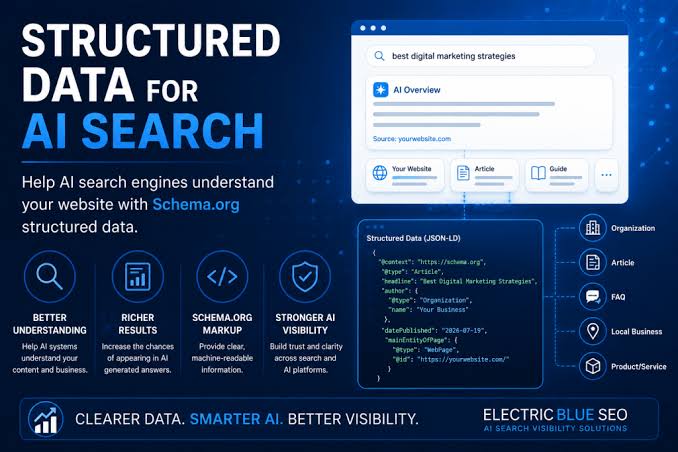
A page can explain a business, product or article clearly to a person while leaving search systems to infer what each detail means. Structured data helps make those details explicit. For an Indian retailer, for example, it can describe a product’s name, price and availability; for a publisher, it can identify an article’s headline, author and publication date. It does not guarantee a special search listing, but it can give search engines and other systems more organised information to interpret.
As search experiences increasingly use artificial intelligence to assemble answers, clear labels for a page’s entities and relationships may also help systems understand its subject. That is one reason to treat structured data as part of a broader publishing and technical strategy, rather than as a shortcut to rankings. This guide to structured data and AI search offers further context on the connection.
What structured data does
Structured data is information presented in a consistent, machine-readable format. On a website, it can describe what a page is about and identify details such as a business address, an event date or a product’s review rating. A common vocabulary is Schema.org, while JSON-LD is one format often used to add that information to a page.
Think of a page about a music event. A reader can recognise the venue, date and ticket details from the text, but a machine may need to interpret those details from their context. Structured data can label the event, its location and its start time separately. The labels do not replace the page’s readable content; they provide an additional, organised description of it.
Choose types that match the page
Begin with the purpose of each page, then consider which structured data type accurately describes it. A product page, news article, local business profile and event announcement have different information needs. Adding a type simply because it seems popular can create inaccurate or confusing markup.
For an Indian business, the useful details will depend on what the page actually offers. A restaurant page might identify its name, address and opening hours. A product page might describe the item and its current price. An article might provide its headline and author. Include only details that are relevant and supported by the visible page.
Be especially careful with ratings, prices, availability and dates, which can change. If the markup says a product is available but the page says it is sold out, the discrepancy undermines trust and may make the data ineligible for certain search features. Keep structured details aligned with the information customers can see.
Build and check the implementation
A practical workflow can prevent common errors:
- Map the page. Identify its main purpose and the facts a visitor needs to understand.
- Select an appropriate type. Use a vocabulary that reflects the actual content, rather than trying to make a page appear to be something it is not.
- Add supported properties. Start with accurate, relevant information. Do not invent details to fill optional fields.
- Validate the output. Check that the markup is syntactically sound and that required information is present for any feature you are pursuing.
- Review after changes. Recheck the page when its template, content or business details change.
Validation tools can catch formatting problems, but passing a test does not guarantee that a search engine will display a rich result or use the data in an AI-generated answer. Eligibility and presentation depend on the search system’s rules and decisions. Treat a successful test as evidence that the markup can be read, not a promise of visibility.
Keep the page useful to people
Structured data should describe a page, not attempt to disguise it. The content visible to visitors should support the claims made in the markup. Do not add fabricated reviews, hide important conditions, or mark up information that is absent from the page. These practices can mislead visitors and may conflict with search engine policies.
It is also important to remember what structured data cannot do. It cannot repair thin writing, inaccurate product information, confusing navigation or a slow, unreliable site. Nor does it make a page authoritative simply by labelling it as an article or business. Helpful content and a sound technical experience remain central to serving readers.
Decide when to bring in a specialist
A small site using a well-supported content management system may be able to add basic markup through a trusted plugin or theme. More complex websites—such as large catalogues, multi-location businesses or sites with custom page templates—may need a developer to map fields, manage updates and prevent conflicting markup. An editor or SEO specialist can also help ensure the chosen details accurately reflect the content.
Before hiring, define the pages involved, the types of data required, who will maintain it and how success will be assessed. Ask a freelancer for relevant implementation examples, their testing process, how they handle changing information and what documentation they will provide. Osdire’s questions to ask before hiring a freelancer can help structure that conversation. Clear scope matters: “add schema” is vague, while “mark up these product templates, validate them and document how stock status stays current” gives both sides a more workable brief.
Measure outcomes realistically
After deployment, monitor technical errors and the search appearance of the relevant pages. Compare performance over a useful period, but avoid attributing every change in clicks or impressions to markup alone. Search demand, competition, content changes and display decisions can all affect results. Record what was implemented and when so that later reviews have a clear baseline.
Structured data is most useful when it makes accurate page information easier for machines to interpret. Choose types carefully, keep the markup consistent with visible content, and maintain it as details change. That disciplined approach can support search understanding without promising a particular ranking, rich result or AI citation.
