
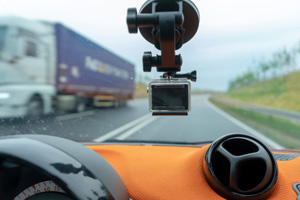
After a serious truck accident, determining exactly what happened can quickly become complicated.
The truck driver may provide one version of events. The injured driver may remember something different. Witnesses can have incomplete views of the collision, and physical evidence at the crash scene can disappear within hours.
Dashcam footage can provide something very different: a visual record of what occurred.
Commercial trucks increasingly use forward-facing cameras, driver-facing cameras, and other onboard monitoring systems. At the same time, passenger vehicles, rideshare drivers, nearby motorists, businesses, traffic systems, and even homes near the crash scene may have cameras capable of capturing important portions of an accident.
When available, video footage can help establish how a truck crash occurred, what the drivers were doing immediately beforehand, and whether factors such as distraction, unsafe following distance, lane changes, or delayed braking contributed to the collision.
The National Transportation Safety Board has repeatedly used onboard commercial-vehicle video in crash investigations and has described such recordings as a source of critical crash-related information.
For someone injured in a truck accident, identifying and preserving that footage as quickly as possible can therefore be an important part of investigating the claim.
Quick Highlights
- Dashcam footage can provide direct visual evidence of the moments before, during, and sometimes after a truck accident.
- Commercial trucks may have forward-facing, inward-facing, side, or rear-facing cameras, but not every truck is equipped with the same technology.
- Video may help document lane position, traffic signals, following distance, braking, driver attention, weather, road conditions, and the sequence of a collision.
- Driver-facing cameras may sometimes provide evidence relating to distraction, fatigue, cellphone use, or other driver behavior.
- Dashcam footage should generally be considered together with electronic logging device records, vehicle data, physical evidence, witness statements, and other information.
- Video files may not be retained indefinitely, making early preservation efforts important.
- Footage from other motorists, businesses, residences, or public cameras may also become valuable evidence.
- Dashcam footage does not always tell the entire story, and camera angle, image quality, timestamps, and missing portions of a recording should be carefully evaluated.
Why Dashcam Footage Can Be So Important After a Truck Crash
Truck accidents can occur in a matter of seconds.
Afterward, investigators may need to answer questions such as:
- Which vehicle entered the lane first?
- Did the truck have enough distance to stop?
- Was traffic already slowing ahead?
- Did the truck driver react before impact?
- Did either vehicle run a traffic signal?
- Was a passenger vehicle in the truck’s blind spot?
- Did the truck drift out of its lane?
- Was the truck following another vehicle too closely?
- Did a driver appear distracted?
- Were weather or roadway conditions a factor?
Without video, answering those questions may require piecing together physical evidence, witness statements, vehicle damage, electronic data, and expert analysis.
Dashcam footage can sometimes show the event directly.
That does not mean a recording automatically establishes legal responsibility. But video can provide investigators with an objective source of information that can be compared with the statements made by drivers and witnesses.
What Types of Cameras May Be Found on Commercial Trucks?
Commercial trucking fleets use a variety of camera and driver-monitoring technologies.
FMCSA has studied and promoted several categories of camera-monitoring technology for commercial vehicles, including forward-facing event recording, in-cab driver-facing systems, and side/rear-view camera systems.
Depending on the carrier and truck, cameras might include:
Forward-Facing Cameras
These cameras generally record the roadway in front of the truck.
They may capture:
- Traffic signals
- Lane markings
- Vehicles traveling ahead
- Sudden stops
- Merging vehicles
- Road hazards
- Weather conditions
- Pedestrians or cyclists
- The moments immediately preceding a collision
A forward-facing camera may be particularly valuable when the parties disagree about how vehicles were positioned before impact.
Driver-Facing Cameras
Some trucks contain cameras directed toward the driver.
These systems may provide information about what the driver was doing immediately before a crash.
Depending on the recording, investigators may potentially observe whether the driver appeared to be:
- Looking toward the roadway
- Looking away from traffic
- Using a cellphone
- Eating or drinking
- Reaching for an object
- Showing signs associated with fatigue or inattention
Driver-facing video has played a meaningful role in actual NTSB investigations. In one commercial-truck crash investigation, inward-facing camera footage allowed investigators to analyze where the truck driver was looking during the seconds immediately preceding the collision.
Importantly, video should not automatically be interpreted beyond what it actually shows. A driver’s facial expression alone, for example, does not necessarily establish fatigue or distraction.
Side and Rear Cameras
Some commercial vehicles may also use cameras to improve visibility around the truck.
These cameras could potentially capture:
- Vehicles traveling alongside the truck
- Cars entering or leaving blind spots
- Lane changes
- Turning movements
- Cyclists or pedestrians
- Vehicles approaching from behind
This can be particularly relevant because tractor-trailers have substantial areas around them where visibility can be limited.
Dashcam Footage Can Help Establish the Sequence of Events
One of the most valuable features of video evidence is its ability to preserve the sequence of a collision.
Consider a multi-vehicle highway accident.
One driver may claim that a passenger vehicle suddenly cut in front of the truck, leaving the truck driver no time to react.
The injured motorist may claim that they had been established in the lane for several seconds and the truck simply failed to slow down.
A forward-facing dashcam could potentially show:
- When the passenger vehicle entered the lane
- How much space existed between the vehicles
- Whether traffic ahead was slowing
- When the truck began responding
- Whether braking occurred before impact
- How the vehicles moved following the initial collision
That visual timeline can help accident reconstruction experts compare what the video shows with physical and electronic evidence.
The NTSB has reported that onboard video has provided critical pre-crash information in commercial-vehicle investigations and, in some cases, captured the pre-crash, crash, and post-crash phases of an accident.
Video Can Help Evaluate Distracted Driving
Distracted driving can be difficult to prove from physical evidence alone.
A driver may deny using a phone. Phone records may establish that communications occurred around the time of an accident but may not necessarily establish exactly what the driver was doing at a specific second.
Driver-facing video can sometimes provide additional context.
A recording might show a driver repeatedly looking down, holding a phone, interacting with another device, or focusing attention somewhere other than the roadway.
Conversely, video may also show that a driver was facing forward and not visibly interacting with an external distraction.
In fact, the NTSB has used inward-facing truck-camera footage to evaluate whether distraction appeared to be involved in a fatal commercial-vehicle crash.
Video therefore does not inherently favor one party. Its value comes from helping investigators determine what actually occurred.
Dashcams May Provide Evidence Relating to Driver Fatigue
Fatigue is another important issue in some truck accident investigations.
FMCSA identifies fatigue and distraction as major risk factors associated with commercial motor vehicle crashes and notes that fatigue can affect attentiveness, reaction time, judgment, and driving performance.
A camera cannot independently diagnose whether a driver was fatigued.
However, driver-facing footage might reveal conduct that becomes relevant when considered alongside other evidence.
That evidence could include:
- Electronic logging device records
- Hours-of-service records
- Work schedules
- Fuel receipts
- Dispatch communications
- Cellphone records
- Driver testimony
- Medical information when legally relevant
For example, investigators may compare video showing the driver’s behavior with records documenting how long the driver had been working and driving.
The complete picture matters more than any single piece of evidence.
Video Can Be Compared With Electronic Logging Device Records
Commercial truck investigations frequently involve much more than cameras.
Many interstate commercial drivers who are subject to federal hours-of-service recordkeeping requirements must use Electronic Logging Devices, or ELDs. These systems are designed primarily to record information related to driver duty status and hours of service.
According to FMCSA, compliant ELDs automatically record information including:
- Date
- Time
- Location information
- Engine hours
- Vehicle miles
- Driver identification
- Vehicle identification
- Motor carrier identification
ELDs are not required to record vehicle speed, braking, steering, or other vehicle-performance parameters.
This distinction matters.
A dashcam, ELD, and vehicle Event Data Recorder may each capture different information.
For example:
Dashcam: What appeared to happen on the roadway.
ELD: Driver-duty information and certain vehicle/time/location information.
Event Data Recorder: Certain technical vehicle information associated with a brief period surrounding a crash.
NHTSA specifically distinguishes Event Data Recorders from devices that capture audio or video and from systems that record truck-driver hours of service.
When these different sources are examined together, investigators may be able to reconstruct an accident much more precisely.
Dashcam Footage May Confirm—or Contradict—Witness Statements
Human memory is not perfect, especially following a sudden and traumatic event.
Drivers may genuinely remember a collision differently.
Witnesses may have seen only part of what happened. Their view may have been obstructed, or they may have focused on one vehicle rather than another.
Video can help investigators evaluate those accounts.
For example, a witness might recall that a truck entered an intersection after a traffic light turned red.
A dashcam recording could potentially show the traffic signal and precisely where the truck was when it changed.
Similarly, video could support—or challenge—a driver’s account of:
- A sudden lane change
- A vehicle cutting into traffic
- A pedestrian entering the roadway
- Emergency braking
- A road obstruction
- Another driver’s behavior
Video does not eliminate the value of eyewitness testimony, but it can provide an additional source against which testimony can be compared.
Trucking Companies May Not Be the Only Source of Footage
After a truck accident, investigators should not assume that the commercial truck’s cameras are the only potential source of video.
Other footage might come from:
- The injured person’s dashcam
- Other motorists
- Rideshare or delivery vehicles
- Other commercial trucks
- Buses
- Nearby businesses
- Gas stations
- Homes with security cameras
- Parking lots
- Traffic cameras
- Highway cameras
Even footage that does not capture the actual impact may still be useful.
A camera located a short distance from the crash could potentially show the truck’s movements, traffic conditions, or vehicle positions shortly before or after the collision.
Identifying those sources quickly can be important because many recording systems continuously overwrite older footage.
Why Dashcam Evidence Should Be Preserved Quickly
Digital video does not necessarily remain available forever.
Different camera systems have different retention practices. Some save footage locally to a memory card. Others transmit event clips to a remote fleet-management platform or cloud system. Some continuously record and overwrite older information.
That means potentially important footage could eventually disappear.
When serious injuries are involved, an attorney may send a preservation letter, sometimes called a spoliation letter, instructing a trucking company or another entity to preserve evidence relevant to reasonably anticipated litigation.
The obligation to preserve evidence can become significant when litigation is pending or reasonably foreseeable. The American Bar Association describes spoliation as destruction or material alteration of evidence, or a failure to preserve evidence for use in pending or reasonably foreseeable litigation.
A truck-accident preservation request might seek protection of evidence including:
- Forward-facing dashcam video
- Driver-facing video
- Side or rear camera footage
- Electronic logging device records
- Event Data Recorder information
- GPS and telematics records
- Driver qualification records
- Dispatch communications
- Inspection and maintenance records
- Cellphone information when relevant
- Post-accident photographs
- Data generated by collision-avoidance systems
The exact evidence relevant to a particular crash will depend on the circumstances.
Other Trucking Records May Have Retention Deadlines
Prompt investigation is also important because different trucking records may be subject to different retention requirements.
For example, FMCSA states that motor carriers subject to the applicable ELD rules generally must retain ELD records of duty status and supporting documents for six months, along with a separate backup copy of the ELD records.
FMCSA also states that when permitted edits are made to ELD records, the original records remain preserved along with information concerning the edits.
Those rules concern ELD records—not dashcam footage—but they demonstrate why truck-accident investigations often involve several different electronic systems with different rules and retention practices.
Waiting too long to investigate can make obtaining some evidence considerably more difficult.
Dashcam Footage Can Help Accident Reconstruction Experts
Serious truck accidents are sometimes analyzed by accident reconstruction experts.
These experts may evaluate information including:
- Vehicle damage
- Tire marks
- Roadway evidence
- Final resting positions
- Vehicle measurements
- Electronic vehicle data
- Photographs
- Police reports
- Witness statements
- Video recordings
Dashcam footage can help provide a visual reference for the expert’s analysis.
The NTSB has reported using commercial-vehicle onboard recordings to analyze factors including vehicle speed, driver behavior, roadway movements, and conditions preceding crashes.
When sufficiently clear, video may allow an expert to examine the relative movements of vehicles frame by frame.
Dashcam Footage Has Limitations
Video can be powerful evidence, but cameras do not necessarily show everything.
Potential limitations include:
- A restricted field of view
- Poor lighting
- Glare
- Weather
- Low frame rates
- Obstructed views
- Missing audio
- Inaccurate timestamps
- Missing portions of a recording
- Low-resolution footage
- Camera movement during impact
The NTSB has specifically identified limitations involving camera positioning and low-light recording capability in commercial-vehicle video systems.
Perspective can also be misleading.
A wide-angle lens may make vehicles appear farther away than they actually were, while a camera mounted high on a tractor can create a significantly different perspective from the view inside a passenger vehicle.
For these reasons, footage should be evaluated in context rather than treated as automatically conclusive.
The Original Video File May Matter
When important dashcam evidence exists, obtaining the original digital file can be preferable to relying solely on a cellphone recording of a screen or a clip uploaded to social media.
The original file may preserve information relating to:
- Recording date
- Timestamp
- File creation
- Video resolution
- Frame rate
- Device information
- Associated event information
Maintaining the integrity of digital evidence is important.
FMCSA’s own enforcement guidance emphasizes preserving the integrity of digital images used in investigations and warns against altering or manipulating visual evidence.
When video becomes significant to a contested case, appropriate forensic procedures may help establish where the footage came from and whether it is complete.
What If the Trucking Company Says There Is No Video?
The absence of footage does not necessarily mean the investigation ends.
An attorney may seek information about:
- Whether the truck was equipped with cameras
- What type of camera system was installed
- Whether recording occurred continuously or only after triggering events
- Where recordings were stored
- The company’s retention policy
- Whether the system uploaded footage to a third-party provider
- Whether footage was reviewed after the accident
- Whether any files were downloaded or preserved
- When footage was deleted or overwritten
Other sources of evidence may also help reconstruct the accident, including ELD information, vehicle data, GPS records, photographs, eyewitnesses, surveillance footage, and physical evidence.
Dashcam Footage Can Be Important to Both Sides
Video evidence does not automatically prove that the truck driver or trucking company was responsible.
A recording could support the injured person’s account.
It could also support the truck driver’s explanation.
For example, footage might show that another vehicle abruptly entered the truck’s lane immediately before impact.
FMCSA itself recognizes video as potentially valuable crash evidence. In its Crash Preventability Determination Program, the agency specifically encourages motor carriers and drivers to submit materials including videos and photographs when supporting a request to establish that a qualifying crash was not preventable.
That is why an attorney should seek relevant footage even before knowing precisely what it will show.
The goal of an investigation should be to preserve and evaluate the available evidence.
What Should You Do If You Have Dashcam Footage of Your Truck Accident?
If your own vehicle recorded the crash, preserve the original footage.
Avoid editing, cropping, applying filters, adding text, or deleting portions of the recording.
If possible, preserve the complete original file and associated recordings from immediately before and after the accident.
You may also want to provide a copy to your attorney rather than posting the video publicly.
Publicly uploading accident footage to social media can create unnecessary complications and may eliminate context surrounding the recording.
If someone else tells you they have video of the collision, obtain their contact information and inform your attorney as soon as possible.
Video Can Help Reveal What Happened in the Seconds That Matter Most
A serious truck accident may lead to months or years of medical treatment, lost income, disability, and litigation.
Yet the event itself may unfold in only a few seconds.
Dashcam footage can sometimes preserve those seconds.
A forward-facing camera may document traffic and vehicle movements. An inward-facing camera may show what the truck driver was doing. Side cameras may reveal the position of another vehicle. Video from nearby motorists or businesses may provide an entirely different perspective.
None of these recordings should automatically be viewed in isolation. But when video is combined with electronic logging records, vehicle data, physical evidence, witness testimony, medical documentation, and accident reconstruction, it can become an important part of determining how a truck crash happened and who may be responsible.
Because digital recordings can potentially be overwritten or lost, identifying and preserving available footage early can be critical.
For someone seriously injured in a truck accident, an experienced personal injury attorney can investigate potential sources of video evidence, send appropriate preservation requests, obtain relevant trucking records, and work with experts when necessary to determine what the available evidence reveals about the collision.
This article is intended for general informational purposes only and does not constitute legal advice. Evidence-preservation obligations, discovery procedures, and the admissibility of video evidence vary depending on the jurisdiction and circumstances of the case.
