
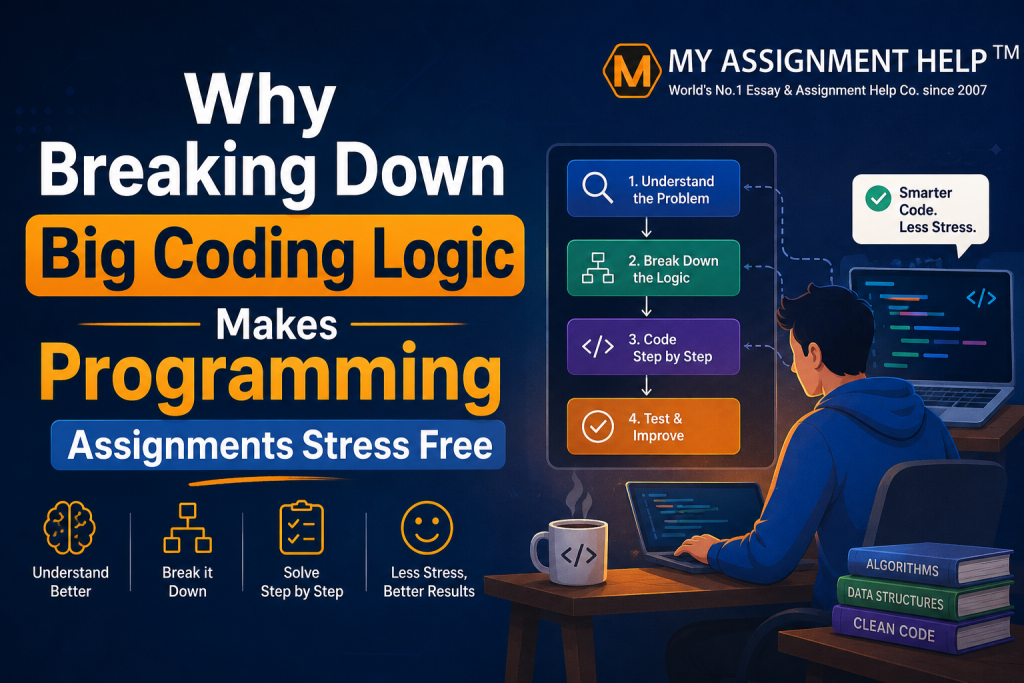
Staring at a blank file in a code editor can be one of the most intimidating moments for a computer science student. When a professor hands out a major programming assignment, the requirements list often looks like an impossible mountain to climb. You might need to build a complex database, create an interactive user interface, and ensure your memory management is completely flawless all at once. Trying to write the entire program in one sitting usually leads to overwhelming mental fatigue. This approach makes it incredibly easy to lose track of your logical flow, resulting in an endless loop of frustrating runtime errors. The secret to managing this stress lies in a fundamental computer science principle: decomposition.
Decomposition is simply the process of breaking a massive, complex problem down into small, isolated, and manageable pieces. When students do not practice this strategy, they often find themselves stuck close to the deadline, desperately searching for someone to do my c++ assignment before the university submission portal closes. Utilizing professional guidance from reliable academic platforms like MyAssignmenthelp can show you exactly how to structure your development process step by step. By learning how to separate your program into distinct modules, you can focus on solving one tiny puzzle at a time. This logical breakdown completely eliminates homework anxiety and ensures your software functions perfectly from start to finish.
The Psychological Power of Small Wins in Coding
Programming requires an immense amount of focus, and trying to process a massive project all at once can easily cause your brain to short-circuit.
Overcoming the Initial Paralysis
When a project feels too large, procrastination naturally takes over. You keep putting off the work because you do not know where to write the very first line of code. By deciding that you are only going to write one simple function today—such as validating user input or reading a text file—you lower the barrier to entry. This small step builds immediate momentum, making it much easier to keep working.
Reducing Cognitive Load
Your working memory can only hold a few pieces of information at a time. When you are writing a piece of software, you have to keep track of variable scopes, data types, and system architecture. If you try to build the entire system simultaneously, your brain gets overwhelmed, and you start making careless syntax mistakes. Focusing on one isolated module allows you to clear your mind and write cleaner, more efficient logic.
Step-by-Step Guide to Deconstructing a Programming Assignment
To transform a stressful coding prompt into a straightforward task, you need a clear strategy for breaking down the instructions.
Read the Prompt and Identify the Sub-Tasks
Before you touch your keyboard, grab a piece of paper and list the core components your program needs to function. If you are building a school grading system, your sub-tasks might include:
- Creating a structure to hold student data
- Writing a loop to calculate average marks
- Designing a function to save the final results to an external file
Build and Test Your Code incrementally
Never write a hundred lines of code and then hit the compile button for the first time. Write a single function, run it, and use print statements to verify that it outputs the correct data. Once you know that specific piece works perfectly, move on to the next one. This practice ensures that if an error pops up later, you know exactly which section of your project caused the bug.
Navigating Different Coding Languages with Confidence
Every programming language has its own distinct quirks and syntax rules, which can add an extra layer of difficulty to your college schedule.
Managing Strict Syntax Requirements
Languages like C and C++ require meticulous attention to detail regarding pointers, memory allocation, and libraries. It is incredibly common for students who are juggling multiple science labs to look for specialized c assignment help when their data structures refuse to link properly. Having access to dedicated academic resources helps you see how experienced developers organize their code architecture. Whether you are dealing with object-oriented design or low-level memory control, seeing a clean, modular example makes it much easier to replicate that success in your own homework.
The Beauty of Reusable Functions
When you break your logic down into distinct functions, you quickly realize that many pieces of code can be reused. A function that sorts numbers or cleans up text strings can be utilized across multiple areas of your assignment. This modular approach saves you hours of repetitive typing and keeps your entire source code incredibly neat and professional.
Long-Term Benefits of Modular Programming
Learning how to dissect complex logic is not just a trick to pass your current class; it is the exact skill that professional software engineers use every day.
Easier Debugging and Maintenance
When a program is written as one giant block of text, finding a bug is like searching for a needle in a haystack. However, if your program is broken into distinct modules, debugging becomes incredibly simple. If your application fails to save data, you do not need to check your user interface code; you can head straight to your file-handling function and fix the issue within minutes.
Preparing for a Successful Tech Career
In the tech industry, developers work in large teams on massive codebases containing millions of lines of code. No single person understands the entire system. Instead, engineers are assigned to work on small, specific features or modules. By mastering the art of decomposition during college, you are developing the exact workflow patterns required to excel in professional software development and technical job interviews.
About the Author
Jack Thomas is a Senior Academic Consultant at MyAssignmenthelp. He has spent more than ten years mentoring computer science students, auditing technical work, and designing clear educational strategies for aspiring developers. Jack is deeply passionate about making software logic accessible, fun, and stress-free for learners worldwide. When he is away from his workstation, Jack enjoys hiking through national parks and dedicating his weekends to local youth mentoring programs.
Frequently Asked Questions
1. What does decomposition mean in computer programming?
Decomposition is the practice of breaking a complex system or problem down into smaller, self-contained parts that are easier to understand, code, and maintain. It is a core pillar of computational thinking.
2. Why does my code have so many bugs when I write it all at once?
When you write large amounts of code without testing, errors accumulate and interact with each other. This makes it incredibly difficult to find the root cause of a crash. Incremental writing and testing eliminate this issue completely.
3. How do I know if my functions are small enough?
A good rule of thumb is that a single function should do exactly one thing. If you find yourself writing a function that validates user data, calculates a metric, and prints a report all in one block, you should split it into three separate functions.
4. Can professional programming support help me learn to code better?
Yes, absolutely. Looking at well-structured, commented code written by an expert serves as an excellent learning template. It helps you understand proper formatting, naming conventions, and efficient logical design.
5. How should I handle an assignment deadline that is only 24 hours away?
Do not panic. Break the project down, identify the core features that carry the most weight in your grading rubric, and build those first. Getting partial credit for a working core program is much better than getting a zero for an incomplete, non-compiling project.
